
Clinical Trials Regulation (EU) No 536/2014 Questions and Answers Document Version 7.3
BACKGROUND
The recently updated Clinical Trials Regulation (EU) No 536/2014 Questions and Answers document, published in July 2026, includes significant revisions to Chapter 7 on Safety Reporting. The latest Version 7.3 supersedes Version 7.2, and aims to provide clarified answers to frequently asked questions regarding the implementation of the Clinical Trial Regulation (CTR).
Substantial amendments have been made to Chapter 7 on Safety Reporting, including the restructuring of Chapter 7 into distinct sub-chapters. Upon review, the comprehensive updates range from the total rewording of some questions and answers with little change in underlying principle, to the addition of new questions and requirements for safety reporting.
TAKE-HOME MESSAGES
This comprehensive re-write can seem difficult to navigate at first. Drive Phase PV has reviewed the document in detail and performed an internal impact assessment. This blog aims to summarise the stand-out changes impacting us and our clients.
Seriousness vs Severity
The definitions of ‘seriousness’ and ‘severity’ have been updated. Additional wording for the definition of seriousness has been added to reinforce that it is a regulatory definition. In terms of severity assessments, Version 7.3 now references the use of the Common Terminology Criteria for Adverse Events (CTCAE) five-point grading scale.
Impact: When we are supporting our clients with the set-up of clinical trials, these updated definitions should be taken into consideration during study design, Protocol development, and PV system set-up.
Reference Safety Information
Sections covering Reference Safety Information (RSI), including purpose, content, and format, have been reworded in Version 7.3; however many reinforce the previous principles outlined in Version 7.2. These include the fact that the RSI should be clearly documented in the Investigator's Brochure (IB), guidance on which SARs can be listed (frequency, indications, inclusion of fatal/life-threatening SARs), and requirements for how to present the data.
Versions 7.2 and 7.3 state that the RSI should be presented as a tabular listing of expected SARs, however Version 7.3 further explains that event frequency should be '(n and %)' and includes the additional requirement for 'frequency category' along with the different frequency definitions. Both versions provide an example of an RSI table, however the table format and content has been updated in Version 7.3. Most notably, Version 7.3 stipulates that if fatal/life-threatening SARs are considered expected for an IMP, this information should now always be included as a table footnote; whereas in Version 7.2 this information was previously presented in the table columns 'Occurrence of fatal SARs' and 'Occurrence of life-threatening SARs'. These two columns have been replaced in Version 7.3 by the 'Frequency category' column.
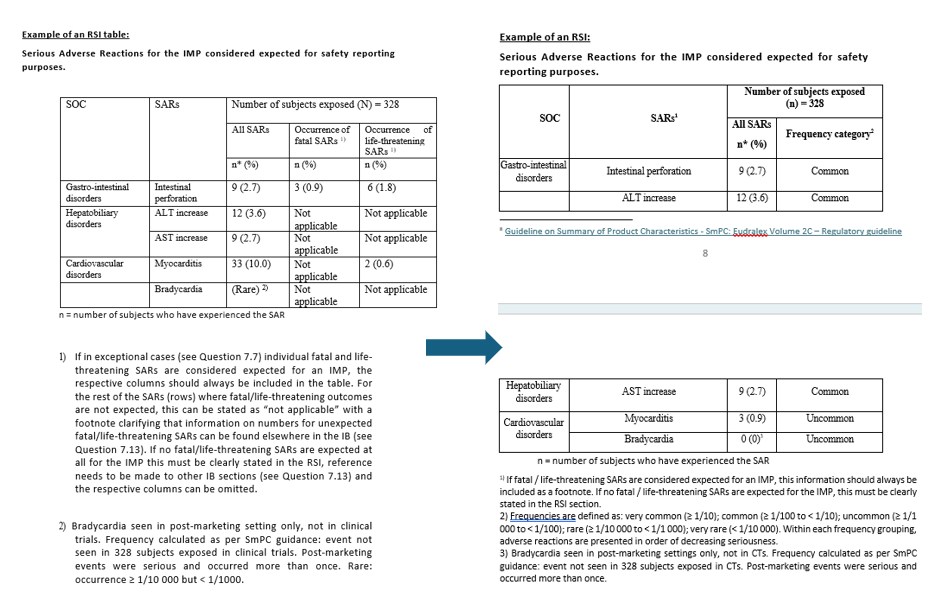
Notably, wording which describes a case involving a positive CHMP opinion, but no Commission’s decision which was present in Version 7.2 has been removed in Version 7.3.
Impact: When we are supporting our clients with RSI input, during both initial IB development and routine IB updates, we can advise on implementation of the new format and content of the RSI table.
SUSAR Nullification vs Downgrading
Version 7.3 includes a completely new question to address whether there is a difference between nullification and downgrading of an earlier reported SUSAR in the EudraVigilance database. It confirms that nullification and downgrading of SUSARs are not equivalent, and provides distinct definitions for both scenarios. Although there is a difference between the two, in both nullification and downgrading of cases, new information leads to a significant change in the report, therefore a follow-up with the relevant information has to be submitted to EVCTM.
Impact: When we are supporting our clients with SUSAR reporting, we can advise on which action is most appropriate and assist with the technical requirements involved.
Abbreviations
In Version 7.3, Annex VI: ABBREVIATIONS (Valid for Chapter 7 on Safety reporting) has been updated to include a list of new terms. These include:
· CCT - Complex clinical trial
· CT - Clinical trial
· EoR - End of recruitment
· ET - Early termination
· GEOT - Global end of trial
· RoR - Restart of recruitment
· RoT - Restart of trial
· SB - Serious breach
· SM - Substantial modification
· SoR - Start of recruitment
· SoT - Start of trial
· Sum - Summary of results
· TH - Temporary halt
· TI - Third country inspection
· UE - Unexpected event
· USM - Urgent safety measure
Impact: When we are supporting our clients, we can demonstrate up-to-date knowledge of current terminology and safety-related abbreviations.
WHAT DOES THIS MEAN FOR YOU?
Hopefully the changes summarised above will help further your understanding of some of the key updates in Version 7.3. If you would like support in understanding a specific area of safety reporting not covered, please do get in touch and we will be very happy to provide a summary tailored to your specific needs.